
 PDF Download
 PubReader
 Export Citation
 Share Facebook
 Share Twitter
 Cited by 0 Article
 Metrics (View:3,594)







I. Introduction
The twenty-first century has witnessed a renewed crisis of global justice, religious tolerance, and humanitarian governance. International courts and human rights institutions increasingly claim that rulers, states, and armed actors must be held accountable for war crimes, crimes against humanity, ethnic persecution, and systematic discrimination. At the same time, these institutions face persistent resistance from state sovereignty, geopolitical alliances, religious nationalism, and selective enforcement. Contemporary debates on the International Criminal Court, the International Court of Justice, secular pluralism, the persecution of minorities, and the protection of vulnerable populations therefore reveal a central unresolved question: how can moral responsibility be translated into durable political and institutional practice?
This question is not entirely new. In the third century BCE, Ashoka the great, who reigned circa 268–232 BCE, confronted the moral consequences of imperial violence after the Kalinga War. Ashoka’s own inscription records the immense suffering caused by the conflict, including 100,000 killed and 150,000 deported, and describes the emperor’s subsequent sorrow and regret (Nikam and McKeon, 1958; Mirajkar et al., 2023; Kiron, 2025). This transformation became the foundation of his turn toward dhamma-vijaya, or conquest through righteousness, rather than conquest through military expansion (Mirajkar, 2023). Ashoka’s dhamma was not merely a private religious sentiment. It was articulated through inscriptions, administrative measures, and public moral exhortations that linked rulership with restraint, compassion, justice, welfare, and religious respect (Nikam and McKeon, 1958; Mirajkar, 2023; Kiron, 2025; Kumari, 2025).
Among Ashoka’s edicts, the Twelfth Pillar Edict occupies a special place because of its explicit concern with religious tolerance. In this edict, Ashoka warns against elevating one’s own religious community by disparaging others and urges respect for the doctrines professed by different sects (Nikam and McKeon, 1958; Mirajkar, 2023; Kiron, 2025). Such language is remarkable because it does not simply endorse the ruler’s own religious preference; rather, it frames interreligious respect as a condition of moral and social order. For this reason, Ashoka has often been discussed in relation to Buddhist political ethics, interfaith dialogue, religious pluralism, and humane governance (Swidler, 2013; Andrabi, 2020). Yet the contemporary relevance of Ashoka requires careful methodological handling. It is easy to overstate his modernity or to treat him as a direct ancestor of contemporary human rights and international criminal law. Such an approach risks collapsing very different historical worlds into a simplistic continuity(<Figure 1>).
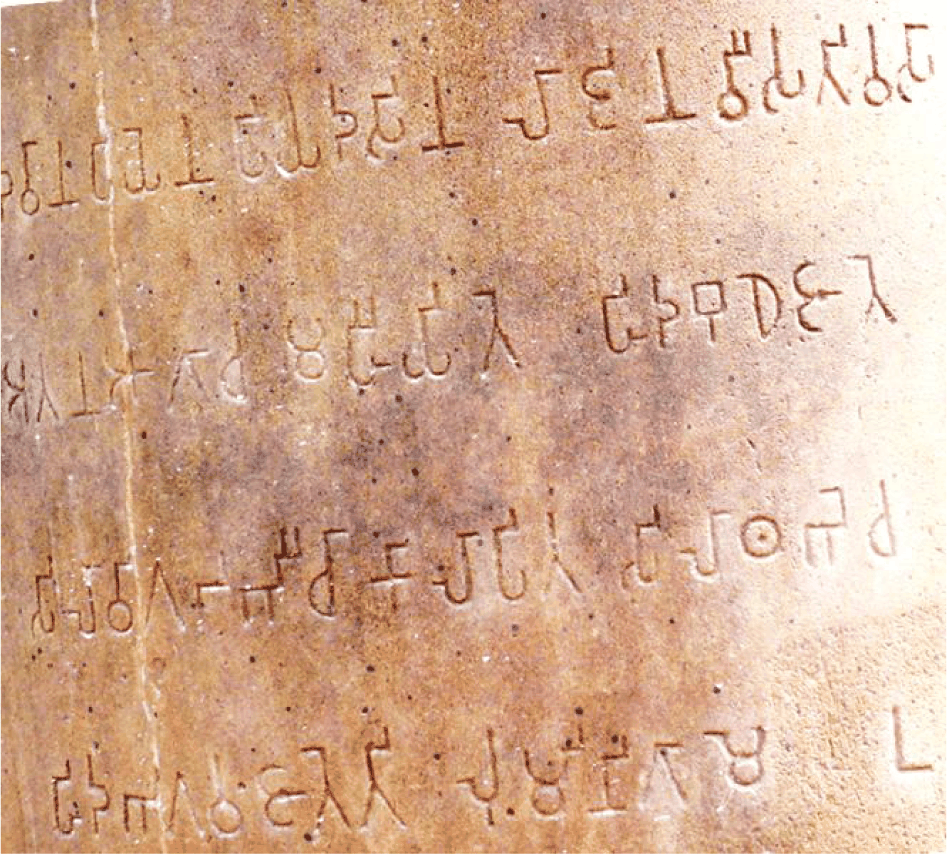
This article therefore adopts a more limited and disciplined argument. It does not claim that Ashoka’s dhamma directly caused, historically generated, or institutionally anticipated the ICC, ICJ, United Nations, or modern human rights regimes. Instead, it treats Ashoka’s dhamma as a normative-comparative framework. In this sense, Ashoka is not used as a genealogical origin of modern global justice, but as an ethical-political reference point through which modern institutions and crises can be examined. The comparison operates at the level of moral structure rather than direct historical influence. Ashoka’s remorse after Kalinga is compared with contemporary demands for accountability after mass violence; his commitment to religious respect is compared with modern struggles over pluralism and secularism; his ideal of welfare-oriented kingship is compared with present debates on humanitarian governance and the protection of vulnerable populations.
The research problem addressed in this article is therefore precise: what does Ashoka’s dhamma contribute to contemporary discussions of global justice and religious tolerance when it is read neither as a direct historical source of modern law nor as a romanticized moral lesson, but as a normative framework with both insights and limits? This problem is important because the modern world possesses far more elaborate legal institutions than Ashoka’s empire did, yet it continues to struggle with the same broad ethical issues: violence without remorse, power without accountability, religion without tolerance, and governance without compassion.
The article is guided by three questions. First, how can Ashoka’s dhamma be interpreted as a public ethical framework rather than as a narrowly sectarian Buddhist doctrine? Second, what are the main convergences and divergences between Ashokan moral governance and contemporary institutions of global justice, religious tolerance, and humanitarian accountability? Third, what limits must be acknowledged when comparing an ancient imperial ethic with modern legal-political institutions?
The central argument is that Ashoka’s dhamma remains significant not because it provides a direct model for contemporary international law, but because it clarifies the ethical dimension that modern institutions often struggle to sustain. Ashoka contributes a vocabulary of remorse, restraint, religious humility, welfare, and moral responsibility. Contemporary institutions such as the ICC, ICJ, human rights regimes, and secular constitutions contribute legal procedures, institutional accountability, and mechanisms of public enforcement (Bajpai, R., 2022; Karovska Andonovska, 2022; Oyelade and Abuloye, 2024; Oyewole, 2024). The comparison between the two reveals both convergence and divergence. They converge in their concern with restraining destructive power and protecting human dignity. They diverge because Ashoka’s framework was imperial, paternal, and morally exhortative, whereas modern global justice is legal, procedural, contested, and dependent on institutional cooperation. Therefore, the article’s original contribution lies in transforming Ashoka’s dhamma from a broadly admired historical ideal into a critically bounded normative-comparative framework for evaluating contemporary accountability, pluralism, and humanitarian governance.
Having clarified the article’s central argument and contribution, the next section explains the methodological basis for this comparison. This is necessary because any comparison between Ashoka’s ancient imperial context and contemporary global governance must avoid both historical overstatement and superficial analogy.
II. Methodology: Normative Comparison, Not Historical Genealogy
This study employs a qualitative, interpretive, and interdisciplinary methodology that combines historical textual analysis, Buddhist ethical interpretation, and comparative political analysis. Its primary historical materials are Ashokan inscriptions, especially those concerned with remorse after Kalinga, dhamma-vijaya, religious tolerance, judicial restraint, and public welfare (Nikam and McKeon, 1958; Mirajkar, 2023; Kiron, 2025; Kumari, 2025). These primary materials are read together with secondary scholarship on Buddhist ethics, ancient Indian political thought, Ashokan kingship, religious pluralism, and the relationship between moral authority and governance (Swidler, 2013; Lahiri, 2015; Ashu, 2018; Bryant, 2018; Andrabi, 2020; Khanna, 2020; Sen, 2022; Bhargava, 2023; Olivelle, 2024; Satsangi, 2024).
The central methodological point is that this article does not adopt a genealogical or causal approach. It does not argue that Ashoka’s dhamma historically produced modern international criminal law, the International Criminal Court, the International Court of Justice, the United Nations, or contemporary human rights regimes. Such a claim would require a different kind of historical evidence and would risk overstating the continuity between an ancient imperial polity and modern international legal institutions. Instead, this study adopts a normative-comparative approach. Ashoka’s dhamma is treated as an ethical-political vocabulary of remorse, restraint, pluralism, welfare, and ruler responsibility. Contemporary global justice institutions are treated as modern legal-political mechanisms that attempt, unevenly and imperfectly, to institutionalize related values such as accountability, human dignity, religious freedom, humanitarian protection, and restraint of violence (Bilder, 2010; Karovska Andonovska, 2022; Oyelade and Abuloye, 2024; Oyewole, 2024).
The comparison therefore operates at the level of moral structure rather than institutional descent. For example, Ashoka’s remorse after the Kalinga War is not presented as the historical origin of modern atrocity accountability. Rather, it is read as an early moral-political articulation of the idea that rulers should acknowledge the suffering caused by violence (Nikam and McKeon, 1958; Mirajkar, 2023; Kiron, 2025). Similarly, the Twelfth Pillar Edict is not treated as a direct source of modern freedom of religion. It is examined as an ancient expression of religious humility and inter-sect respect that can be placed in normative dialogue with modern pluralism and human rights discourse (Nikam and McKeon, 1958; Bilder, 2010; Mirajkar, 2023; Sajir, 2023; Kiron, 2025). This approach allows the article to compare Ashokan and contemporary frameworks without collapsing their historical differences.
This distinction is necessary because Ashoka’s Mauryan Empire and the contemporary international order differ radically in political structure, social organization, legal procedure, and conceptions of personhood. Ashoka governed as an emperor in a hierarchical imperial society. Modern international law operates through treaties, courts, states, civil society, and contested norms of sovereignty. Ashoka’s dhamma was expressed largely through royal edicts and moral exhortation. Modern global justice depends on codified law, institutional jurisdiction, evidence, procedure, and enforcement. Because of these differences, the article does not treat Ashokan dhamma as equivalent to modern international law. Rather, it uses Ashoka as a heuristic and critical lens: a way of asking what contemporary institutions gain through legal codification and what they may lose when moral responsibility is separated from political power.
The study proceeds in three analytical stages. First, it reconstructs Ashoka’s dhamma from the edicts and related scholarship as a public ethic organized around four themes: remorse and accountability, ahimsa and restraint, religious tolerance, and welfare-oriented governance (Lahiri, 2015; Ashu, 2018; Khanna, 2020; Bhargava, 2023; Olivelle, 2024; Kumari, 2025; Kushwaha, 2025). Second, it compares these themes with selected modern norms, including international criminal accountability, freedom of religion, secular pluralism, humanitarian law, and protection of vulnerable populations (Bilder, 2010; Karovska Andonovska, 2022; Sajir, 2023; Oyelade and Abuloye, 2024; Oyewole, 2024). Third, it tests the usefulness and limits of this comparison through three focused case clusters rather than a broad survey of global events. These case clusters are: ICC/ICJ accountability as a test of global justice; Nepal and the Rohingya crisis as contrasting tests of religious tolerance; and Afghanistan as a case of humanitarian governance failure and gender-based persecution.
The selected cases are illustrative rather than exhaustive. They are not intended to prove that Ashoka’s dhamma determines modern political outcomes. Rather, they serve as focused examples through which the article examines where Ashokan ethical categories remain analytically useful and where they reach their limits. This restricted case selection also prevents the argument from becoming a general report on global crises. The aim is depth of interpretation, not comprehensive coverage.
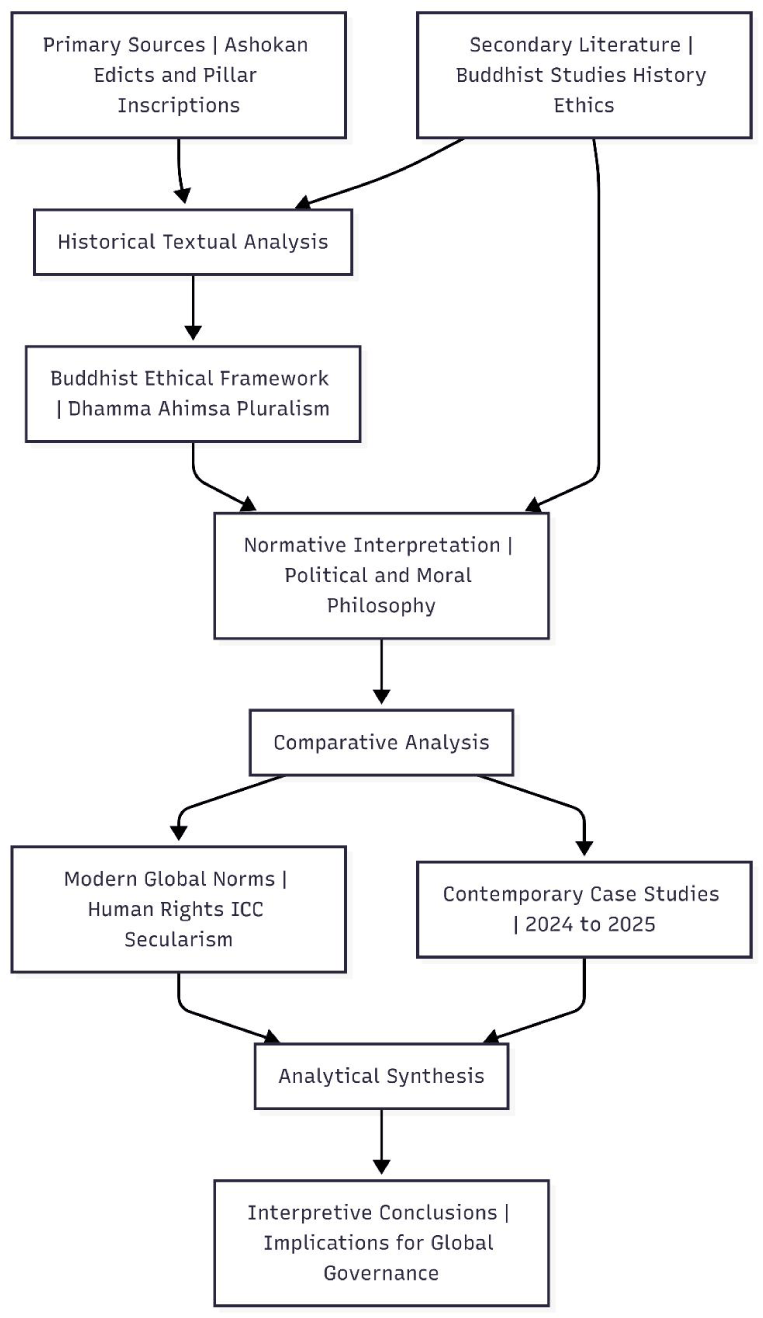
The <Figure 2> illustrates how Ashokan textual sources and Buddhist ethical scholarship are used to reconstruct dhamma as a moral-political framework, which is then compared with selected modern norms and case studies without claiming direct historical influence. <Figure 2> presents the methodological logic of the article. The first stage begins with Ashokan edicts and pillar inscriptions as primary sources. These are interpreted through secondary literature in Buddhist studies, history, and ethics. Together, these sources allow the reconstruction of Ashoka’s dhamma as a Buddhist ethical-political framework rather than as a narrowly sectarian doctrine. The second stage moves from historical reconstruction to normative interpretation, where concepts such as ahimsa, pluralism, remorse, justice, and welfare are clarified as moral categories. The third stage places these categories in comparison with modern global norms and selected contemporary cases. The final stage synthesizes the comparison by identifying convergences, divergences, and limits. Thus, each arrow in <Figure 2> represents an analytical transition: from source material to historical interpretation, from historical interpretation to ethical reconstruction, from ethical reconstruction to contemporary comparison, and from comparison to critical synthesis.
Following the methodological clarification that this study uses normative comparison rather than historical genealogy, this section reconstructs Ashoka’s dhamma as a moral-political framework rooted in the post-Kalinga transformation of kingship.
III. Ashoka’s Dhamma as Moral-Political Governance
Ashoka’s historical significance lies not only in his association with Buddhism but also in his attempt to connect moral reflection with the practice of rule. In the early phase of his reign, Ashoka appears in historical and Buddhist sources as a ruler shaped by the ordinary violence of imperial consolidation. Later traditions, including the Aśokāvadāna, portray him as harsh and even cruel, although such accounts contain legendary elements and must be read critically (Lahiri, 2015). The turning point in both the historical and moral memory of Ashoka’s reign was the Kalinga War. Rock Edict XIII records the immense human suffering caused by the conquest, including 100,000 deaths and 150,000 deportations (Nikam and McKeon, 1958; Lahiri, 2015; Keuning, 2021). More important than the numbers alone is the ethical language that follows them: Ashoka acknowledges sorrow and regret for the suffering caused by imperial violence (Nikam and McKeon, 1958; Mirajkar, 2023; Kiron, 2025). This public acknowledgment is central to his later image as a ruler who sought to redirect power through dhamma.
After Kalinga, Ashoka did not simply withdraw into private remorse. He attempted to reshape the moral vocabulary of governance. His commitment to dhamma-vijaya, or conquest through righteousness, marked a shift from the celebration of military expansion to the promotion of restraint, welfare, and ethical persuasion (Mirajkar, 2023). This did not mean that Ashoka abolished political power or abandoned the machinery of empire. Rather, he sought to discipline rulership through a public ethic. His dhamma therefore should not be read narrowly as a sectarian Buddhist doctrine imposed on the population. Although Ashoka was deeply associated with Buddhism, his inscriptions often present dhamma in broad ethical terms: kindness, truthfulness, restraint, generosity, purity, respect, and concern for the welfare of all (Kumar, 2017; Satsangi, 2024; Kiron, 2025; Kushwaha, 2025). This inclusive character is one reason his edicts remain relevant to discussions of public ethics and religious pluralism.
Four elements of Ashokan dhamma are especially important for the present study. The first is remorse and ruler accountability. Ashoka’s response to Kalinga presents the ruler not as a figure beyond moral judgment but as one who must confront the suffering produced by his own policies. His admission of regret is significant because it transforms violence from a sign of imperial glory into a moral problem requiring restraint and correction (Nikam and McKeon, 1958; Mirajkar, 2023; Olivelle, 2024; Kiron, 2025). In this sense, Ashoka’s dhamma begins with a moral reorientation of sovereignty.
The second element is ahimsa, or non-harming. Ashoka’s edicts express a strong concern with the reduction of violence toward human beings and animals (Bhargava, 2023; Kushwaha, 2025). He restricted animal sacrifice, reduced royal hunting, supported medical facilities, and promoted welfare measures for people and animals (Taylor, 2004; Kumar, 2017). These policies do not make Ashoka an absolute pacifist in the modern sense. He remained an emperor and retained the coercive structure of rule. Yet his significance lies in the fact that he placed restraint at the centre of governance. Violence was no longer to be celebrated as the natural language of power; it had to be morally justified, limited, and subordinated to dhamma.
The third element is religious tolerance. The Twelfth Pillar Edict remains one of the clearest expressions of Ashoka’s public ethic. It warns that praising one’s own sect by disparaging another harms one’s own religion and undermines moral order (Nikam and McKeon, 1958; Mirajkar, 2023; Kiron, 2025). Ashoka’s point is not merely that different communities should be tolerated as a matter of political convenience. Rather, he suggests that genuine commitment to one’s own path requires humility toward others. This is why his religious tolerance is ethically richer than mere administrative neutrality. His appointment of Dhamma Mahāmātras to promote welfare and inter-sect harmony further indicates that tolerance was not only a verbal ideal but also an administrative concern (Biswas, 2008; Ashu, 2018; Khanna, 2020; Bhargava, 2023; San, 2024).
The fourth element is welfare-oriented governance. Ashoka’s inscriptions describe public works such as wells, roads, rest houses, gardens, medical care, and concern for prisoners and vulnerable groups (Lahiri, 2015; Olivelle, 2024; Satsangi, 2024). Such measures reflect a conception of rulership in which public authority is judged by its capacity to reduce suffering and promote welfare. Ashoka’s statement that he regarded his subjects as his children expresses a paternal model of rule (Lahiri, 2015; Ashu, 2018; Bhargava, 2023; Kushwaha, 2025). From a modern perspective, this paternalism has limits, but historically it marks an important attempt to bind political authority to moral responsibility.
Ashoka’s dhamma must be interpreted critically because it emerged within an imperial monarchy, not a democratic constitutional order. It depended heavily on the conscience, charisma, and administrative authority of a single ruler. Its implementation at the local level remains uncertain, and later historians have debated whether Ashoka’s ethical policies weakened the Mauryan Empire’s political or military cohesion after his death (Bryant, 2018; Olivelle, 2024). Ashoka also did not possess modern concepts of citizenship, universal rights, gender equality, constitutional accountability, or international law. For these reasons, his dhamma cannot be treated as a ready-made blueprint for contemporary governance. Its value lies elsewhere: it provides an early and powerful example of political power being subjected to moral self-criticism, religious humility, restraint, and welfare-oriented responsibility.
This critical reconstruction is essential for the comparative argument of the article. If Ashoka is romanticized as a perfect ruler, the comparison becomes historically naïve. If he is dismissed as merely an ancient emperor, the ethical innovation of his edicts is lost. A balanced reading recognizes both dimensions. Ashoka’s dhamma was morally ambitious but institutionally fragile. It placed ethical responsibility at the heart of rulership, yet it lacked the legal and procedural mechanisms that modern institutions claim to provide. The comparison with contemporary global justice therefore begins from this dual recognition: Ashoka offers a compelling moral vocabulary, but modern governance requires durable institutions capable of sustaining moral commitments beyond the conscience of a single ruler.
This reconstruction provides the basis for comparison. Once Ashoka’s dhamma is understood as a historically situated but ethically ambitious model of moral-political governance, it becomes possible to examine where it converges with, and diverges from, contemporary global norms.
IV. Ashokan Dhamma and Contemporary Global Norms
The comparison between Ashoka’s dhamma and contemporary global justice must be handled with caution. Ashoka’s edicts emerged from the context of ancient imperial kingship, whereas modern international norms are articulated through treaties, courts, constitutional frameworks, human rights documents, and multilateral institutions. For this reason, Ashoka’s dhamma should not be described as a direct precursor of modern international law. The more defensible claim is that Ashoka’s dhamma and contemporary global justice share certain moral concerns while differing profoundly in institutional form, legal language, and mechanisms of enforcement.
The first area of convergence concerns accountability after violence. Ashoka’s remorse after the Kalinga War is significant because it presents a ruler publicly recognizing the suffering caused by his own military action (Mirajkar, 2023; Kiron, 2025). In contemporary global governance, accountability after mass violence is pursued through legal institutions such as the International Criminal Court and the International Court of Justice (Karovska Andonovska, 2022; Oyelade and Abuloye, 2024; Oyewole, 2024). The resemblance is not institutional but ethical. Ashoka’s remorse represents a moral-political response to violence; modern courts represent legal-procedural mechanisms for investigating and judging atrocity crimes. Both are concerned with the idea that power should not remain morally immune after causing large-scale suffering. Yet the difference is equally important. In Ashoka’s case, accountability depended on the ruler’s own conscience and self-transformation. In modern international law, accountability is ideally externalized through institutions, evidence, jurisdiction, and formal judgment.
The second area of convergence concerns the restraint of violence. Ashoka’s post-Kalinga turn toward dhamma-vijaya and his emphasis on ahimsa indicate an attempt to subordinate political power to moral restraint (Bhargava, 2023; Mirajkar, 2023; Kushwaha, 2025). Contemporary international law similarly condemns aggressive warfare and seeks to protect civilians through humanitarian law, the Geneva Conventions, and related norms (Oyelade and Abuloye, 2024). Again, the comparison is normative rather than historical. Ashoka did not possess the language of international humanitarian law, nor did he operate within a system of sovereign states. Nevertheless, his edicts articulate a moral intuition that remains central to modern global order: that the deliberate infliction of suffering for conquest, domination, or political pride requires ethical limitation.
The third area of convergence concerns religious tolerance. The Twelfth Pillar Edict urges respect for all sects and criticizes the practice of praising one’s own religion by denigrating another (Mirajkar, 2023; Kiron, 2025). Modern human rights discourse, especially the right to freedom of thought, conscience, and religion, similarly protects religious plurality and condemns coercion or discrimination on religious grounds (Bilder, 2010; Sajir, 2023). Yet the difference between the two remains crucial. Ashoka’s tolerance was framed as a royal moral policy within an imperial order. Modern religious freedom is framed as an individual and collective right within legal and constitutional systems. Ashoka’s model depends on moral exhortation and administrative oversight, whereas modern pluralism depends on rights, law, courts, civic institutions, and public culture.
The fourth area of convergence concerns welfare-oriented governance. Ashoka’s edicts repeatedly associate rulership with the welfare of subjects, including medical care, roads, wells, rest houses, prisoners, and animals (Lahiri, 2015; Olivelle, 2024; Satsangi, 2024). Contemporary governance expresses similar concerns through human rights, humanitarian law, sustainable development, and the expectation that states protect vulnerable populations (Karovska Andonovska, 2022; Oyelade and Abuloye, 2024; Oyewole, 2024). However, Ashoka’s welfare ethics were paternal and monarchical. Modern humanitarian governance is expected to operate through rights, public accountability, and institutional responsibility. The comparison therefore reveals an important difference between benevolent rulership and accountable governance. Ashoka’s model asks whether a ruler is morally responsible; modern institutions ask whether systems can protect people even when rulers fail.
These convergences are meaningful, but they must not obscure the divergences. Ashoka’s dhamma was not a legal code comparable to the Rome Statute, the Geneva Conventions, or human rights treaties. It was a moral-political discourse issued by an emperor. Its authority came from royal proclamation and ethical persuasion. Contemporary global justice, by contrast, claims legitimacy through law, procedure, treaty obligations, jurisdiction, and international recognition (Oyelade and Abuloye, 2024; Oyewole, 2024). This distinction matters because moral ideals without durable institutions may disappear after a ruler’s death, while legal institutions without moral commitment may become selective, politicized, or ineffective.
A second divergence concerns political structure. Ashoka ruled a centralized empire. Modern global justice operates in a fragmented international order composed of sovereign states, international organizations, courts, civil society actors, and competing geopolitical interests. This makes enforcement difficult. Even when modern institutions articulate universal norms, powerful states may resist them, ignore them, or apply them selectively. Ashoka’s challenge was how to make an empire ethical; the modern challenge is how to make a divided international order accountable.
A third divergence concerns the subject of justice. Ashoka’s edicts speak of subjects, sects, prisoners, animals, officials, and communities. Modern international law speaks of citizens, individuals, victims, protected groups, refugees, women, minorities, and humanity. This conceptual difference should not be ignored. Ashoka’s dhamma contains a broad ethical concern for life and welfare, but it does not articulate modern rights-based categories in the strict sense. Therefore, the paper’s argument is not that Ashoka already possessed modern human rights language, but that his dhamma offers an early ethical vocabulary that can be placed in dialogue with later rights-based and legal frameworks.
The most important insight emerging from this comparison is that Ashoka and modern institutions solve different parts of the same moral problem. Ashoka provides ethical imagination: remorse, restraint, humility, plural respect, and welfare as the moral responsibilities of power. Modern institutions provide legal codification: courts, procedures, treaties, monitoring systems, and standards of accountability. The weakness of Ashoka’s model is institutional fragility. The weakness of modern global justice is selective enforcement and the frequent absence of moral-political will. The comparative value of Ashoka’s dhamma lies precisely in bringing these two dimensions into conversation.
As <Table 1> shows, the relationship between Ashokan dhamma and modern global norms is best understood as partial normative convergence combined with major structural difference. The value of the comparison lies not in proving that modern law descends from Ashoka, but in showing that ancient and modern frameworks both confront the same enduring ethical problem: how to restrain power, protect plurality, and transform moral responsibility into durable public practice.
| Ashokan principle | Textual or ethical basis | Modern comparison | Type of convergence | Key limitation |
|---|---|---|---|---|
| Remorse and ruler accountability | Ashoka’s sorrow after Kalinga and his turn toward Dhamma-Vijaya (Nikam and McKeon, 1958; Mirajkar, 2023; Kiron, 2025) | ICC/ICJ accountability for atrocity crimes (Karovska Andonovska, 2022; Oyelade and Abuloye, 2024; Oyewole, 2024) | Both reject the idea that rulers may cause mass suffering without moral or legal consequence | Ashoka’s accountability is self-imposed and moral; modern accountability is legal but often selectively enforced |
| Ahimsa and restraint | Condemnation of unnecessary killing and emphasis on non-harming (Bhargava, 2023; Kushwaha, 2025) | Humanitarian law, anti-aggression norms, protection of civilians (Oyelade and Abuloye, 2024) | Both seek to restrain destructive violence | Ashoka retained imperial coercive power; modern law struggles with enforcement and state resistance |
| Religious tolerance | Twelfth Pillar Edict’s respect for all sects and criticism of sectarian denigration (Nikam and McKeon, 1958; Mirajkar, 2023; Kiron, 2025) | Freedom of religion, secular pluralism, human rights protections (Bilder, 2010; Sajir, 2023) | Both affirm respect across religious difference | Ashoka’s tolerance is royal policy; modern tolerance requires constitutional and civic institutionalization |
| Welfare-oriented governance | Public works, medical care, prisoners’ welfare, roads, wells, and rest houses (Lahiri, 2015; Olivelle, 2024; Satsangi, 2024) | Humanitarian governance, human dignity, SDG-related institutional responsibility (Karovska Andonovska, 2022; Oyelade and Abuloye, 2024; Oyewole, 2024) | Both connect legitimate governance with protection of welfare | Ashoka’s model is paternal; modern systems require accountable rights-based institutions |
| Moral education and public ethics | Edicts, dhamma officers, ethical exhortation, and administrative concern for moral order (Biswas, 2008; Ashu, 2018; Khanna, 2020; Bhargava, 2023; San, 2024) | Civic education, interfaith dialogue, human rights culture, institutional monitoring (Andrabi, 2020; Swidler, 2013; Ismail, 2024) | Both recognize that law alone is insufficient without public ethical formation | Moral education may become state paternalism if not balanced by freedom, pluralism, and critique |
The preceding section established the normative basis of comparison by distinguishing moral convergence from institutional difference. This section applies that framework to three focused case clusters in order to test the analytical usefulness and limits of Ashokan ethical categories in contemporary settings.
V. Case-Based Analysis: Ashokan Principles under Contemporary Pressure
This section applies that comparison to three focused case clusters. The purpose is not to provide a comprehensive survey of contemporary global crises, but to examine how Ashokan ethical categories illuminate selected modern dilemmas. The cases have been deliberately narrowed to avoid excessive breadth and to allow deeper analysis. The first case cluster concerns ICC/ICJ accountability and the problem of global justice. The second concerns Nepal and the Rohingya crisis as contrasting tests of religious tolerance. The third concerns Afghanistan as a case of humanitarian governance failure and gender-based persecution.
Ashoka’s remorse after the Kalinga War is one of the earliest recorded examples of a ruler publicly associating conquest with moral sorrow rather than triumph (Nikam and McKeon, 1958; Mirajkar, 2023; Kiron, 2025). This does not make Ashoka a modern legal thinker, nor does it make his dhamma an ancestor of international criminal law. However, it does provide a useful ethical point of comparison for contemporary institutions that seek to hold rulers, officials, and states accountable after mass violence. The ICC and ICJ represent legal-institutional attempts to confront war crimes, genocide, crimes against humanity, and violations of humanitarian law (Karovska Andonovska, 2022; Oyelade and Abuloye, 2024; Oyewole, 2024). Their function is not merely punitive; they also express the idea that political authority cannot place itself beyond judgment.
The comparison with Ashoka is therefore illuminating but limited. In Ashoka’s case, the moral response to violence began from the ruler’s own acknowledgment of suffering. In modern international justice, accountability is ideally external to the ruler. It is pursued through investigation, evidence, judicial procedure, jurisdiction, and international legal standards (Oyelade and Abuloye, 2024; Oyewole, 2024). This difference is fundamental. Ashoka’s remorse shows the ethical importance of self-limitation; modern courts show the institutional importance of external accountability when rulers do not repent.
The recent use of international legal mechanisms in relation to contemporary conflicts illustrates both the promise and fragility of this modern framework. The ICC’s actions regarding allegations of war crimes, including those linked to senior political and military leaders, demonstrate that international criminal law aspires to treat even powerful figures as accountable under universal standards (Karovska Andonovska, 2022; Alsemeiri et al., 2025). Similarly, ICJ proceedings concerning allegations of genocide and state responsibility show that international law increasingly challenges the idea that sovereignty can shield mass suffering from scrutiny (Allen, 2012). From an Ashokan perspective, these developments appear ethically significant because they refuse to treat mass violence as a mere instrument of state policy.
Yet these same developments also reveal the central weakness of modern global justice: selective enforcement. Some states cooperate with international courts; others reject jurisdiction, resist enforcement, or frame accountability as political bias. The manuscript’s original comparison between Ashoka and the ICC becomes stronger when this weakness is acknowledged directly. Ashoka’s dhamma lacked independent legal institutions and depended on the emperor’s moral transformation. Modern international justice possesses legal institutions but often lacks the political cooperation required to enforce them. The two systems therefore have opposite weaknesses. Ashoka had moral authority without durable institutional independence. Modern courts have institutional form but face geopolitical resistance.
This comparison clarifies the article’s broader argument. Ashoka contributes the moral idea that rulers should not be proud of violence and must recognize suffering. Modern international law contributes procedures that can, at least in principle, hold rulers accountable even when they refuse remorse. Neither is sufficient alone. Moral remorse without institutions can vanish with the ruler. Institutions without moral and political support can become symbolic, selective, or ineffective. The continuing challenge of global justice is therefore to unite ethical responsibility with enforceable accountability.
Religious tolerance is the clearest point of connection between Ashoka’s dhamma and contemporary pluralism. The Twelfth Pillar Edict does more than advise peaceful coexistence. It criticizes the spiritual arrogance of praising one’s own community by disparaging others and recommends respectful engagement across religious difference (Mirajkar, 2023; Kiron, 2025). This ethical logic remains highly relevant in modern societies where religion continues to shape national identity, minority rights, political mobilization, and conflict.
Nepal offers one example of the difficulty of institutionalizing pluralism. The country’s constitutional shift toward secularism was intended to provide equal space for multiple religious communities within a modern democratic framework (Khanal, 2020; Pant, 2024; Lawoju, 2025). In normative terms, this resembles Ashoka’s concern that the state should not simply become an instrument of one sect against others. Yet Nepal also demonstrates that constitutional language alone cannot guarantee social acceptance. Religious identity, monarchy nostalgia, political instability, and social anxiety can generate resistance to secular pluralism (Khanal, 2020; Pant, 2024; Lawoju, 2025). This case therefore supports one of the central insights of Ashoka’s edicts: tolerance must be cultivated, not merely proclaimed. Ashoka attempted such cultivation through edicts, officers, and repeated moral exhortation (Biswas, 2008; Ashu, 2018; Khanna, 2020; Bhargava, 2023; San, 2024). Modern Nepal must attempt it through constitutional law, civic education, interfaith dialogue, and democratic institutions.
The Rohingya crisis in Myanmar presents a far more tragic contrast. In a Buddhist-majority society, the persecution and displacement of the Rohingya Muslim minority reveal how religious identity can be politicized against a vulnerable group (Rikhof, 2022; Alfredsson and Eide, 2023). This situation stands in direct opposition to the spirit of the Twelfth Pillar Edict. Ashoka’s dhamma warned against sectarian contempt; the Rohingya crisis shows the destructive consequences of religious nationalism, ethnic exclusion, and state violence. The crisis is especially significant for Buddhist ethics because it demonstrates that Buddhist identity, when fused with nationalism and fear, can be used in ways that contradict compassion, non-harming, and plural respect.
The comparison between Nepal and Myanmar is analytically useful because the two cases show different forms of pressure on religious tolerance. Nepal illustrates the difficulty of maintaining secular pluralism amid democratic contestation. Myanmar illustrates the collapse of pluralism under militarized ethnic-religious exclusion. In both cases, Ashoka’s dhamma offers neither a legal solution nor an institutional blueprint. What it offers is a moral test: does the state protect religious diversity, or does it allow one identity to dominate, humiliate, or erase another?
Modern institutions attempt to answer this question through human rights norms, constitutional protections, international monitoring, and judicial proceedings (Bilder, 2010; Karovska Andonovska, 2022; Sajir, 2023; Oyelade and Abuloye, 2024; Oyewole, 2024). However, as with global accountability, law alone is not enough. Nepal’s constitutional secularism requires public legitimacy. Myanmar’s Rohingya crisis requires not only legal condemnation but also political transformation, accountability, and social reconstruction. Ashoka’s relevance lies in reminding contemporary societies that religious tolerance is not passive coexistence; it requires active restraint in speech, policy, and state power.
Ashoka’s dhamma also connected legitimate rule with the welfare of subjects. His inscriptions describe public works, medical care, concern for prisoners, roads, wells, rest houses, and moral attention to the vulnerable (Lahiri, 2015; Olivelle, 2024; Satsangi, 2024). Although this model was paternal and imperial, it expressed a clear expectation: rulers must reduce suffering rather than intensify it. This expectation provides a useful normative lens for examining contemporary failures of humanitarian governance.
Afghanistan under Taliban rule represents a severe case of such failure. The systematic exclusion of women and girls from education, employment, public visibility, and civic participation has created a form of governance based not on welfare but on enforced vulnerability. From a modern legal perspective, such practices raise issues of human rights, gender persecution, and crimes against humanity (Leisner, 2022). From an Ashokan perspective, they represent a failure of the ruler’s duty of care. A ruler who deliberately denies dignity, education, and social participation to a large section of the population cannot be described as governing through dhamma in any meaningful sense.
The comparison must again remain carefully limited. Ashoka’s world did not contain modern gender-rights discourse, and it would be historically inaccurate to present him as a modern feminist or human rights theorist. Nevertheless, his public ethic of welfare, non-cruelty, and concern for subjects can be used to critique governance that produces systematic suffering. In this sense, Afghanistan illustrates the gap between moral legitimacy and coercive control. A regime may hold power, but power alone does not create legitimate governance.
Modern international mechanisms, including the ICC, attempt to name and respond to such abuses through legal categories such as crimes against humanity and gender persecution (Leisner, 2022). These mechanisms represent something that Ashoka’s world lacked: an external legal language for judging rulers who harm their own populations. Yet their limitations are also evident. Without cooperation, enforcement, and internal political change, international warrants or condemnations may remain largely symbolic. Afghanistan therefore exposes the same central tension identified earlier: moral clarity and legal codification do not automatically produce protection.
The case of Afghanistan helps refine the article’s conclusion. Ashoka’s dhamma is valuable because it insists that governance must be judged by the suffering or welfare of those subject to power. Modern institutions are valuable because they attempt to codify that judgment beyond the conscience of rulers. But the protection of vulnerable populations requires more than either moral language or legal declaration. It requires institutions, social legitimacy, international pressure, and political transformation. Afghanistan therefore shows both the continuing relevance and the insufficiency of Ashokan moral idealism when confronted with modern authoritarian violence.
Taken together, these three case clusters show that Ashokan dhamma remains analytically useful where questions of accountability, religious tolerance, and humanitarian responsibility are at stake. They also show that moral ideals require institutional support if they are to protect vulnerable populations in practice. The discussion now draws these insights together.
VI. Discussion: Ethical Imagination, Institutional Limits, and the Problem of Power
The comparison developed in this article suggests that Ashoka’s dhamma remains valuable not because it provides a direct institutional model for contemporary global governance, but because it clarifies a moral problem that modern institutions continue to face: how can power be restrained by ethical responsibility? Ashoka’s response to Kalinga placed remorse, restraint, tolerance, and welfare at the centre of rulership (Lahiri, 2015; Ashu, 2018; Mirajkar, 2023; Olivelle, 2024; Kiron, 2025; Kushwaha, 2025). Modern global justice institutions attempt to address similar concerns through law, courts, human rights standards, and international monitoring (Bilder, 2010; Karovska Andonovska, 2022; Oyelade and Abuloye, 2024; Oyewole, 2024). The comparison therefore reveals a productive tension between ethical imagination and institutional design.
Ashoka contributes ethical imagination. His edicts show that a ruler can publicly acknowledge violence as a moral failure rather than glorify it as political victory. This is significant because political power often seeks to justify harm through necessity, conquest, security, or identity. Ashoka’s post-Kalinga transformation disrupts this logic by treating suffering as a reason for self-limitation (Nikam and McKeon, 1958; Mirajkar, 2023). His dhamma also contributes a language of religious humility. The Twelfth Pillar Edict does not merely tolerate other sects as a practical necessity; it argues that disparaging others damages one’s own religious integrity (Mirajkar, 2023; Kiron, 2025). This insight remains relevant in societies where religious identity is frequently mobilized for exclusion, nationalism, or violence.
Ashoka also contributes a welfare-based understanding of political legitimacy. His concern with medical care, roads, wells, rest houses, prisoners, animals, and vulnerable communities indicates that governance should be evaluated by its capacity to reduce suffering (Lahiri, 2015; Olivelle, 2024; Satsangi, 2024). Even though his model was paternal and imperial, it articulated a principle that remains central to modern political ethics: legitimate rule is not simply the possession of authority but the responsible use of authority for the welfare of those subject to it. This principle is relevant to contemporary humanitarian governance, especially in contexts where states or regimes harm the very populations they claim to govern.
Modern institutions contribute what Ashoka’s model lacked: legal codification, procedural accountability, and the possibility of judgment beyond the ruler’s conscience. The ICC, ICJ, human rights law, humanitarian law, and related global frameworks attempt to transform moral responsibility into rules, procedures, evidence, jurisdiction, and public standards (Karovska Andonovska, 2022; Oyelade and Abuloye, 2024; Oyewole, 2024). This institutional dimension is essential because history shows that moral rulership is fragile when it depends primarily on individual conscience. Ashoka’s dhamma was powerful because Ashoka himself embraced it; its long-term durability after his reign was far less certain (Bryant, 2018; Olivelle, 2024). Modern institutions seek to solve this problem by creating structures that survive individual rulers.
However, modern institutions have their own fragility. Their weakness is not the absence of legal vocabulary but the difficulty of enforcement. International courts and human rights regimes often depend on state cooperation, political will, and geopolitical alignment. As a result, universal norms may be applied inconsistently or resisted by powerful actors (Allen, 2012; Karovska Andonovska, 2022; Oyelade and Abuloye, 2024; Oyewole, 2024; Alsemeiri et al., 2025). This problem does not invalidate modern global justice, but it reveals that legal codification alone is insufficient. Institutions require moral legitimacy, political support, public trust, and a culture of accountability. Without these, law can become symbolic or selective.
The central tension, therefore, is between moral universalism and political power. Ashoka’s dhamma offers moral universalism in the form of remorse, restraint, religious respect, and welfare responsibility. Yet it lacks independent institutional enforcement. Modern global justice offers institutional enforcement in principle, but it is often constrained by sovereignty, selective compliance, and realpolitik. The comparison shows that neither moral exhortation nor legal procedure is sufficient by itself. Ethical governance requires both moral formation and institutional durability.
This insight also clarifies the role of Buddhist ethics in contemporary public thought. Ashoka’s example demonstrates that Buddhist ethical principles such as compassion, non-harming, humility, and concern for suffering can be translated into public and political language. Yet the comparison also warns against romanticizing Buddhist kingship. Ashoka was an emperor, not a democratic constitutional ruler. His dhamma was inclusive but paternal. His edicts promoted moral order but did not establish modern rights-based citizenship. Therefore, the value of Ashoka for contemporary Buddhist political ethics lies not in imitation but in critical adaptation. His legacy invites reflection on how Buddhist moral resources can contribute to pluralism, justice, and public responsibility without becoming instruments of state paternalism or religious nationalism.
<Figure 3> summarizes this analytical synthesis. The figure begins with the core elements of Ashokan dhamma: tolerance, non-violence, justice, and moral leadership. These principles generate the first key insight of the article: ethics can be institutionalized, but institutionalization is always fragile. The figure then shows that modern global norms partially converge with Ashokan concerns, especially in the areas of freedom of religion, humanitarian restraint, and accountability. At the same time, the figure identifies divergences such as selective enforcement, realpolitik, and sovereignty backlash. These convergences and divergences lead to the central tension of the article: moral universalism versus political power. The lower part of the figure shows the article’s balanced conclusion. Ashoka contributes ethical imagination, responsibility, and moral critique; modern institutions contribute legal codification, courts, and monitoring. Both sides also carry risks: Ashokan idealism may remain fragile without institutions, while modern institutions may remain ineffective without moral and political commitment. The final implication is that humane governance requires both moral responsibility and durable institutional practice.
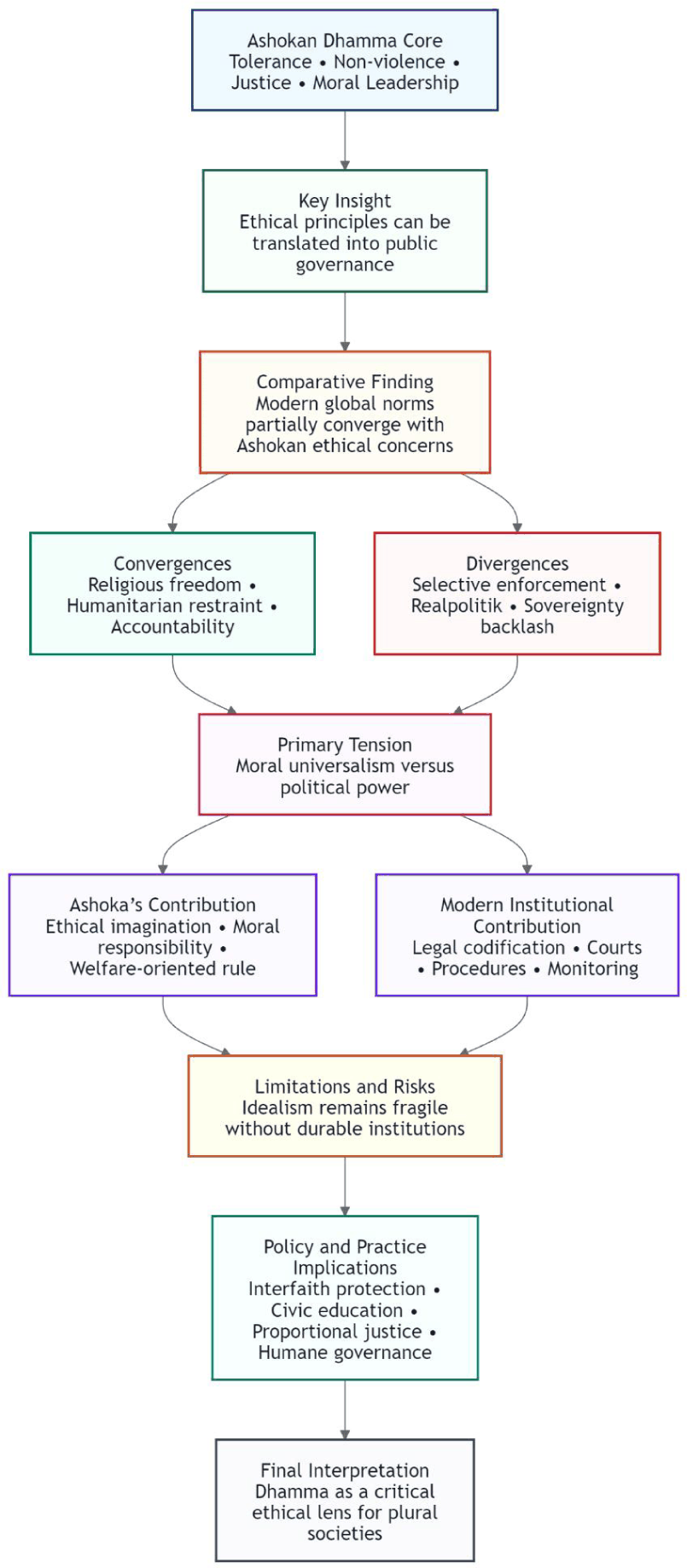
The <Figure 3> presents Ashokan dhamma as a normative ethical framework centred on tolerance, non-violence, justice, and moral leadership. It shows how modern global norms partially converge with Ashokan ethical concerns while also revealing divergences such as selective enforcement, realpolitik, and sovereignty backlash. The synthesis highlights the central tension between moral universalism and political power and interprets dhamma as a critical ethical lens for plural societies.
The analytical synthesis clarifies the value of the comparison, but it also requires methodological caution. The following limitations define the boundaries within which Ashoka’s dhamma can be responsibly used as a comparative ethical lens.
VII. Limitations of the Study
This study has limitations that define the proper scope of the comparison between Ashoka’s dhamma and contemporary global justice. Ashoka ruled within an ancient imperial monarchy, whereas modern global justice operates through sovereign states, courts, treaties, human rights regimes, civil society, and multilateral institutions. These contexts differ in political structure, legal language, social organization, and institutional procedure; therefore, the comparison cannot be treated as equivalence. The article does not establish a historical genealogy from Ashoka to modern international law, nor does it claim that dhamma directly shaped the ICC, ICJ, United Nations, Geneva Conventions, or human rights documents. The selected cases—ICC/ICJ accountability, Nepal and the Rohingya crisis, and Afghanistan—are illustrative rather than exhaustive. Ashoka’s dhamma was morally ambitious but institutionally fragile and dependent on royal authority. Later Buddhist narratives also contain legendary elements (Lahiri, 2015). Thus, dhamma is used here as a critical ethical lens, not as a complete solution to contemporary crises.
VIII. Conclusion
Ashoka’s dhamma remains significant for contemporary thought not because it directly anticipated modern international law, but because it formulated an early moral-political grammar of remorse, restraint, religious tolerance, and welfare-oriented governance. After the Kalinga War, Ashoka transformed the meaning of rulership by presenting violence as a source of sorrow rather than glory and by linking political authority to moral responsibility (Mirajkar, 2023; Kiron, 2025). His edicts did not create a modern legal order, but they did articulate enduring ethical questions: how should rulers respond to suffering caused by their own power, how should religious communities relate to one another, and how should governance be judged by its treatment of the vulnerable?
This article has argued that Ashoka’s dhamma should be read as a normative-comparative framework rather than as a historical genealogy of modern global justice. When placed in dialogue with contemporary institutions such as the ICC, ICJ, human rights regimes, and secular constitutional frameworks, Ashoka’s dhamma reveals both convergence and difference. The convergence lies in shared concern for accountability, restraint of violence, religious respect, and public welfare. The difference lies in institutional form. Ashoka’s dhamma was royal, moral, and exhortative; modern global justice is legal, procedural, and institutionally mediated (Karovska Andonovska, 2022; Oyewole, 2024).
The focused case studies demonstrate the usefulness of this comparison. ICC/ICJ accountability shows the modern effort to judge mass violence through legal institutions, while also revealing the problem of selective enforcement and political resistance. Nepal and the Rohingya crisis show that religious tolerance remains fragile, whether challenged through democratic contestation or destroyed through ethnic-religious persecution. Afghanistan shows that governance loses moral legitimacy when it systematically denies dignity, education, and public participation to vulnerable populations. In each case, Ashoka’s dhamma does not provide a ready-made policy solution, but it offers a moral lens through which the failure or success of governance can be evaluated.
Therefore, ethical governance requires both moral responsibility and institutional durability. Ashoka’s example reminds modern institutions that law without moral seriousness can become procedural, selective, or politically constrained. Modern institutions remind Ashokan idealism that moral exhortation without independent enforcement may remain fragile and dependent on individual rulers. The task for contemporary global governance is therefore not to imitate Ashoka, but to learn from the ethical force of his dhamma while strengthening the legal and institutional mechanisms that his world lacked.
For Buddhist studies, Ashoka remains a crucial figure because he demonstrates that Buddhist ethical concepts can enter public life without being reduced to sectarian domination. His dhamma, at its best, expresses compassion, non-harming, humility, and respect across difference. For global governance, Ashoka remains relevant because he shows that the moral transformation of power is possible, even after extreme violence. Yet his legacy also warns that moral transformation must be institutionalized if it is to endure. In this sense, Ashoka’s dhamma is neither an ancient blueprint nor a merely historical curiosity. It remains a critical ethical resource for asking whether global justice is only a matter of legal procedure, or whether law itself requires a deeper moral commitment to remorse, restraint, pluralism, and the reduction of suffering.


